
When Your Back Is Against
the Wall, We Are Right
There With You
the Wall, We Are Right
There With You
California Criminal Defense and Restraining Order Firm
















Last updated March 22, 2026 // Attorney reviewed by Matthew Barhoma
If a family member has filed a gun violence restraining order against you, the timeline starts immediately—not when you are ready. A judge can issue an ex parte GVRO the same day the petition is filed, without hearing your side, and once served, you have 24 hours to surrender every firearm, part, and round of ammunition you possess.
This is not a routine civil matter. It is a fast-moving legal process that can suspend your Second Amendment rights based solely on a sworn statement from a spouse, parent, sibling, or other qualifying relative under Penal Code § 18150.
Power Trial Lawyers defends individuals facing family-filed GVROs across Southern California. Our role is direct: challenge whether the petitioner legally qualifies, dismantle unsupported allegations, and force the court to apply the correct evidentiary standard at the contested hearing.
If you have been served, the hearing is already approaching. What you do before that hearing determines the outcome.
A family-filed gun violence restraining order (GVRO) is a civil court order initiated by an immediate family member under California Penal Code § 18150 that prohibits the respondent from owning, possessing, purchasing, or receiving firearms and ammunition.
Governing statute: Penal Code §§ 18150 (ex parte GVRO) and 18170 (GVRO after hearing)
Who qualifies as “immediate family”: Spouse, domestic partner, parent, child, sibling, grandparent, grandchild, in-law, step-relative, or any person related by blood or marriage within the second degree (fourth degree if substantial and regular contact for at least one year)
Key timeline: Ex parte GVRO lasts up to 21 days. A full hearing must occur within that window. If issued after hearing, the order lasts one to five years.
Legal standard: Ex parte requires “substantial likelihood” of significant danger. After-hearing GVRO requires clear and convincing evidence.
What to do now: If you have been served with an ex parte GVRO, you are legally required to surrender firearms within 24 hours. Contact a GVRO defense attorney immediately to understand your rights and prepare for the hearing.
Power Trial Lawyers defends clients against family-filed gun violence restraining orders across Southern California.
If you have been served with an ex parte GVRO, your response in the next 24–72 hours is critical.
Step 1: Comply with firearm surrender requirements
You must surrender all firearms, parts, ammunition, and magazines within 24 hours. Noncompliance is a separate criminal offense.
Step 2: Confirm your hearing date and deadline to respond
The hearing will occur within approximately 21 days. You must be prepared before that date—not on it.
Step 3: Preserve evidence immediately
Save text messages, emails, social media posts, and any communications referenced in the petition. Do not delete anything.
Step 4: Identify the petitioner’s motive and relationship
Whether the case arises from divorce, family conflict, or a mental health concern directly affects your defense strategy.
Step 5: Prepare a targeted defense—not a general denial
Courts do not deny GVROs because you say “this is not true.” The defense must address the statutory elements under Penal Code §§ 18150 and 18170.
Power Trial Lawyers builds that defense before the hearing—not during it.
A family-filed gun violence restraining order is a civil petition brought by an immediate family member under Penal Code § 18150 asking a court to prohibit the respondent from possessing, purchasing, or controlling any firearms or ammunition. Power Trial Lawyers defends respondents against these petitions in courts throughout Southern California, challenging both the factual basis and the legal sufficiency of the family member’s claims.
California enacted its GVRO statute as part of the state’s red flag law framework. Unlike a domestic violence restraining order, a GVRO does not require allegations of abuse, threats, or any specific criminal conduct directed at the petitioner. The petitioner must show only that the respondent poses a significant danger of causing personal injury to themselves or others through access to firearms.
The GVRO statute defines ‘immediate family member’ in Penal Code § 18150(a)(3). This includes a spouse or domestic partner, parent, child, sibling, grandparent, grandchild, and their respective spouses. It also covers in-laws, step-relatives, and anyone related by blood or marriage within the second degree. Relatives within the fourth degree qualify if they have had substantial and regular interactions with the respondent for at least one year.
This broad definition means that extended relatives you rarely see could potentially file a GVRO petition if they meet the interaction threshold. A family-filed GVRO defense attorney evaluates whether the petitioner actually qualifies under the statutory definition and whether their petition meets the required legal standard.
Understanding how the court evaluates a GVRO petition is central to defeating it.
“Significant danger”
The court must find that you pose a significant danger of causing personal injury to yourself or others through access to firearms. General conflict, arguments, or emotional distress are not enough without a firearm-related risk.
“Substantial likelihood” (ex parte stage)
For a temporary GVRO, the judge must believe there is a substantial likelihood that danger exists in the near future. This decision is made without your input.
“Clear and convincing evidence” (hearing stage)
At the full hearing, the burden increases. The petitioner must present evidence that is highly and substantially more likely to be true than not.
“Less restrictive alternatives”
The court must consider whether options short of a GVRO—such as voluntary storage or intervention—were attempted or available.
Each of these elements creates an opportunity for defense. If even one is not satisfied, the GVRO should not issue.
The family-filed GVRO process operates in two stages under California law. First, the family member may seek an ex parte order under Penal Code § 18150 without prior notice to the respondent. If granted, a full hearing follows within 21 days under Penal Code § 18170. Power Trial Lawyers intervenes as early as possible to prepare the strongest defense for the contested hearing.
The family member files a petition (Judicial Council Form GV-100) supported by a sworn written affidavit. The court reviews the petition the same day it is filed. The respondent does not receive advance notice and has no opportunity to contest the petition at this stage.
To grant the ex parte GVRO, the court must find a substantial likelihood that both of the following are true. First, the respondent poses a significant danger in the near future of causing personal injury to themselves or another by having access to firearms. Second, less restrictive alternatives have been tried and found ineffective, or are inadequate or inappropriate for the circumstances.
If the court grants the ex parte order, it takes effect immediately upon service. The respondent must surrender all firearms, firearm parts, ammunition, and magazines within 24 hours to law enforcement or a licensed firearms dealer.
The court schedules a hearing within 21 days of the ex parte order. The respondent must be personally served at least five calendar days before the hearing date. At the full hearing, the standard of proof increases. The petitioner must prove by clear and convincing evidence that the respondent poses a significant danger and that the order is necessary.
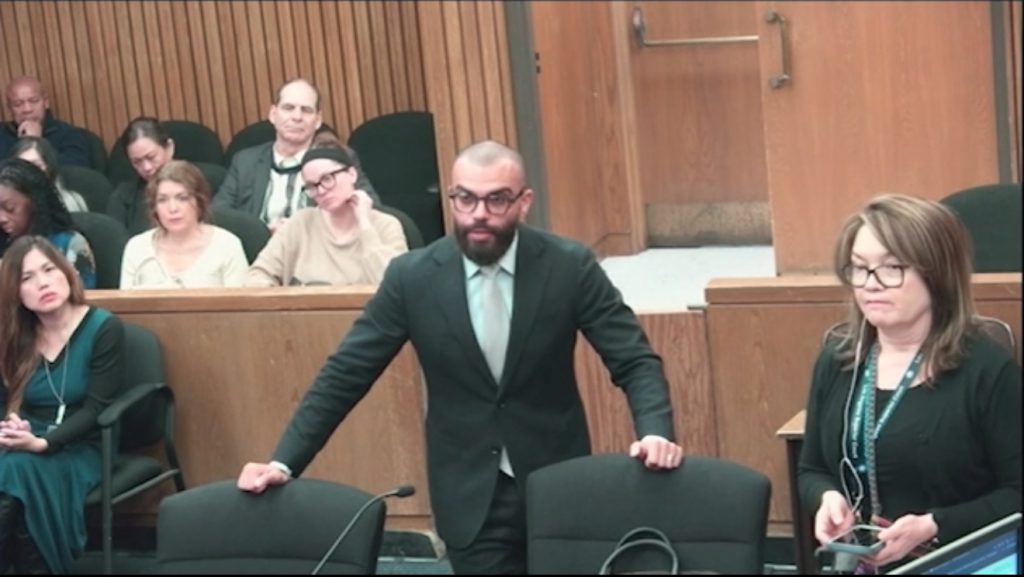
This is the critical moment in any family-filed GVRO defense. The respondent has the right to appear, present evidence, call witnesses, and cross-examine the petitioner. If the court grants the order after hearing, it can last between one and five years.
A gun violence restraining order issued under the family petition process prohibits the respondent from owning, possessing, purchasing, receiving, or attempting to acquire any firearms, firearm parts, ammunition, magazines, or body armor. Power Trial Lawyers ensures every client understands both the scope and the limits of what a GVRO can impose.
A GVRO cannot order the respondent to move out of their home. It cannot impose stay-away distances or no-contact orders. It cannot address child custody, visitation, or support. Those provisions belong to other restraining order types, such as a [Link to DVRO main page — sibling cross-reference] domestic violence restraining order or a [Link to civil harassment main page — cross-type reference] civil harassment restraining order.
However, if the family member also pursues a DVRO or other protective order alongside the GVRO, the combined effect can be far more restrictive. Understanding which orders are in play and what each actually requires is essential to mounting an effective defense.
A family-filed GVRO carries serious consequences that extend well beyond temporary firearm restrictions. Power Trial Lawyers fights to prevent these outcomes for every client we represent.
Family-filed GVROs arise from a wide range of circumstances. Many involve genuine concern, but others involve misunderstanding, exaggeration, or family conflict that has nothing to do with actual danger. These are scenarios Power Trial Lawyers regularly encounters.
A spouse files a GVRO during a contentious divorce or custody battle. The petition may reference arguments, emotional outbursts, or general tension rather than any specific threat involving firearms. The GVRO becomes a tactical tool in the family law proceeding. A family-filed GVRO defense attorney can expose the lack of firearm-specific danger and present the filing context to the court.
A parent files a GVRO after their adult child experiences a mental health crisis, such as a psychiatric hold or a period of severe depression. While the concern may be genuine, the petition must still meet the statutory standard. The court must find that the respondent poses a significant danger of causing injury through firearm access, not merely that the respondent is going through a difficult time.
Family disputes over money, property, or inheritance sometimes escalate into GVRO petitions. A sibling or in-law files a petition citing heated arguments or vague statements taken out of context. Power Trial Lawyers investigates the family dynamics to show the court that the petition is driven by personal conflict rather than genuine firearm danger.
A family member reads a social media post, text message, or overheard statement and interprets it as threatening. The petition relies on this single piece of evidence without context. Effective defense involves presenting the full context of the communication and demonstrating that it does not meet the statutory threshold for a GVRO.
In some cases, a family member files a GVRO as retaliation after the respondent reported domestic violence, elder abuse, or financial misconduct by the petitioner. Or, commonly is the situation is that a GVRO matter will be filled a domestic violence restraining order petition has been filed. Exposing this retaliatory motive can be decisive at the hearing.
Power Trial Lawyers appears regularly in GVRO hearings across Southern California and has direct experience challenging family-filed petitions at both the ex parte and contested hearing stages. This includes cases involving divorce-related filings, mental health allegations, and claims based on isolated statements taken out of context.
Several Judicial Council forms apply specifically to the family-filed GVRO process. Respondents should be familiar with these forms when preparing for a hearing.
The most important form for the respondent is GV-120. Filing a response before the hearing is not legally required, but it provides the court with your side of the case in writing and signals that you intend to contest the petition.
Most GVRO petitions are not defeated by broad arguments. They are defeated by precision.
A successful defense typically focuses on one or more of the following:
The hearing is not about telling your story. It is about forcing the court to apply the statutory standard correctly.
Defending a family-filed GVRO requires a targeted strategy that addresses both the legal standard and the family dynamics driving the petition. Power Trial Lawyers brings focused experience in GVRO defense to every case.
Not every family member qualifies as an “immediate family member.” If the petitioner is a distant relative who lacks the required substantial and regular interactions, the petition may fail on standing alone. We scrutinize whether the petitioner meets the statutory relationship and contact requirements.
The petition must demonstrate a significant danger of personal injury through firearm access. Vague assertions of anger, family tension, or general unease are not enough. We challenge the quality, credibility, and specificity of the evidence submitted with the petition. We also address hearsay, since California courts have allowed hearsay at GVRO hearings, making it critical to counter unreliable statements with direct evidence.
The statute requires the court to find that less restrictive alternatives have been tried and found ineffective, or are inadequate. If the petitioner never attempted voluntary storage arrangements, mental health intervention, or direct conversation before filing, we use this to argue the GVRO is premature and unnecessary.
We gather and present evidence that the respondent is a safe, responsible firearm owner. This can include evidence of proper storage, training certifications, clean criminal history, employment records, character witnesses, and mental health evaluations. We also present evidence of the petitioner’s motive, including any ongoing family disputes, litigation, or personal conflicts.
At the full hearing, the respondent has the right to cross-examine the petitioner. This is often the most decisive phase of a GVRO case. Our attorneys probe inconsistencies in the petition, question the petitioner’s actual knowledge of the respondent’s behavior, and expose any ulterior motives behind the filing.
A family-filed GVRO directly restricts Second Amendment rights through a civil proceeding. While California courts have generally upheld GVROs against constitutional challenge, due process arguments remain available, particularly where the petition relies on weak or stale evidence. We raise these arguments when they strengthen the defense.
Under Penal Code § 18200, any person who files a GVRO petition knowing the information to be false or with the intent to harass is guilty of a misdemeanor. Of course, an unsuccessful petition is not the same as a false petition. Criminal liability under § 18200 requires proof that the petitioner knowingly submitted false information or filed with the intent to harass. Power Trial Lawyers raises this issue when the evidence shows the petitioner fabricated or materially exaggerated the basis for the petition. While this criminal provision does not directly defeat the GVRO at hearing, it undercuts the petitioner’s credibility and can support a finding that the statutory standard has not been met.
The respondent may file one written request per year to terminate an active GVRO under Penal Code § 18185. The court will terminate the order if it finds that clear and convincing evidence no longer supports the findings required under § 18175(b). The burden framework at termination mirrors the original standard, not a preponderance standard. Power Trial Lawyers helps clients build a record of compliance, stability, and changed circumstances to support early termination.
Yes. A GVRO does not require allegations of domestic violence, abuse, or any criminal conduct. Your spouse qualifies as an immediate family member under Penal Code § 18150(a)(3), and can file a petition if they believe you pose a significant danger of causing personal injury through access to firearms. Power Trial Lawyers defends clients who face GVRO petitions even when no abuse has been alleged.
A GVRO restricts only firearm possession. It cannot order you to stay away from the petitioner, move out of your home, or change custody arrangements. A DVRO can impose all of those restrictions and more. However, a family member may file both a GVRO and a DVRO simultaneously.
Yes. California courts have accepted social media posts as evidence in GVRO proceedings. A family member can cite posts, messages, or photos they believe demonstrate a danger. However, the court must evaluate whether the post actually demonstrates a significant danger of personal injury through firearm access, not just general anger or frustration.
If the court grants an ex parte GVRO (Form GV-110), you must surrender all firearms, firearm parts, ammunition, and magazines within 24 hours of being served. You can turn them in to law enforcement or store them with a licensed firearms dealer. Failure to comply is a misdemeanor.
Yes. If the court denies the petition at the hearing, the GVRO is dissolved. You can retrieve your firearms from the law enforcement agency or firearms dealer where they were stored. The return process is governed by Penal Code § 33850 and may take several weeks.
Yes. A parent qualifies as an immediate family member regardless of the respondent’s age. If you are a legal adult, your parent can file an ex parte GVRO petition under Penal Code § 18150 or request a GVRO after hearing under Penal Code § 18170. Power Trial Lawyers represents adult respondents facing parental GVRO petitions.
You can present any relevant evidence, including testimony from witnesses, mental health evaluations, firearm safety certifications, evidence of safe storage practices, employment records, and communications that contradict the petitioner’s claims. An experienced attorney can organize this evidence for maximum impact at the hearing.
No. A GVRO is a civil restraining order. It is issued through a civil process under the Penal Code, but it does not result in a criminal conviction. However, violating a GVRO is a criminal offense under Penal Code § 18205, and a GVRO can have collateral effects on criminal cases, custody proceedings, and professional licensing.
Only if you qualify as an eligible petitioner under Penal Code § 18150 and you have an independent basis for the petition. Filing a retaliatory GVRO without a good-faith factual basis could result in criminal liability under Penal Code § 18200. Consult an attorney before filing any counter-petition.
An ex parte GVRO lasts up to 21 days. If the court issues a GVRO after the full hearing, it can last between one and five years. The petitioner may seek renewal before the order expires. The respondent may request termination once per year during the order’s effective period.
No. The petitioner must present facts showing a significant danger of personal injury through firearm access. General fear, without supporting evidence tied to firearms, is insufficient under California law.
If the petitioner knowingly submits false information, they may face criminal liability under Penal Code § 18200. More immediately, false or exaggerated claims can undermine their credibility and lead the court to deny the GVRO.
Ex parte orders are frequently granted because the respondent is not present. However, at the full hearing, the outcome depends on whether the petitioner can meet the clear and convincing evidence standard. Many petitions fail when properly challenged.
Family-filed GVROs are heard in Superior Courts across Southern California. Courtroom procedures, judicial temperament, and local practices vary by county and courthouse. Power Trial Lawyers appears regularly in GVRO proceedings throughout the region, giving our clients the advantage of local courtroom experience.
In Los Angeles County, family-filed GVRO hearings may be scheduled at the Stanley Mosk Courthouse, the Van Nuys Courthouse, the Pasadena Courthouse, the Long Beach Courthouse, the Torrance Courthouse, the Airport Courthouse, or the Santa Monica Courthouse, depending on the filing location.
In Orange County, cases are typically heard at the Central Justice Center in Santa Ana, the Lamoreaux Justice Center in Orange, the Harbor Justice Center in Newport Beach, the North Justice Center in Fullerton, or the West Justice Center in Westminster.
In Riverside County, hearings take place at the Riverside Historic Courthouse, the Southwest Justice Center in Murrieta, or the Larson Justice Center in Indio.
In San Bernardino County, GVRO matters are heard at the San Bernardino Justice Center, the Rancho Cucamonga Courthouse, or the Victorville Courthouse.
In San Diego County, proceedings are handled at the Central Courthouse in downtown San Diego, the Vista Courthouse, or the Chula Vista Courthouse.
Knowing how a specific courthouse handles GVRO hearings, what evidence presentation methods each judicial officer prefers, and how local clerks process filings makes a measurable difference in the outcome. Power Trial Lawyers brings that courtroom-level familiarity to every family-filed GVRO defense.
If a family member has filed a gun violence restraining order against you, or if you have been served with an ex parte GVRO, the time to act is now. You have a limited window before the hearing, and what you do in that window determines the outcome. Power Trial Lawyers has extensive experience defending restraining order cases across Southern California, including contested GVRO hearings involving complex family dynamics.
Call 888-808-2179 for a consultation. You can also reach us through our online contact form. We represent respondents in family-filed GVRO cases in Los Angeles, Orange County, Riverside, San Bernardino, and San Diego.